Framing Deep Sky Objects Without Go-To
```html
The Art of Manual Deep Sky Object Framing: A Return to Roots
In an age dominated by computerized mounts and automated star-hopping software, manually locating deep sky objects (DSOs) has become a nearly forgotten skill. Yet this practice offers unparalleled satisfaction, sharpens observational instincts, and fosters a deeper connection with the night sky. Let’s explore how to navigate celestial wonders without digital aids.
Understanding Celestial Navigation Basics
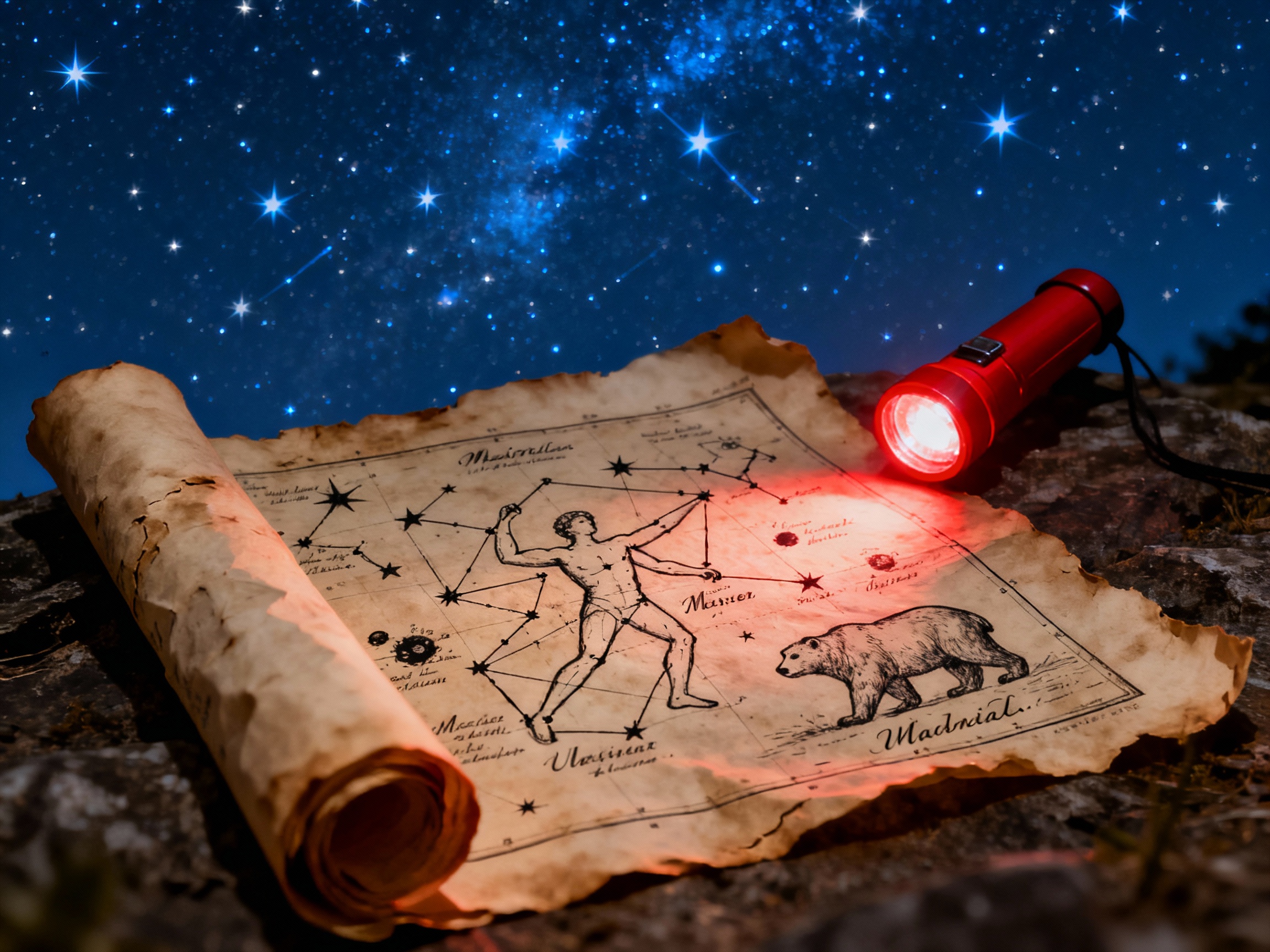
Successful manual framing begins with celestial literacy. Learn anchor constellations visible in your season – Orion’s belt points to the Rosette Nebula, while Cassiopeia’s ‘W’ shape leads to the Andromeda Galaxy. Understand equatorial coordinates: right ascension acts as celestial longitude, declination as latitude. Create custom finder charts using free software like Stellarium, but print them without automated position markers to develop self-reliance.
Essential Tools for Analog Astronomy
Equip yourself with a quality equatorial mount featuring precise right ascension and declination locks. A 8x50 finderscope provides sufficient aperture for spotting guide stars, while a crosshair eyepiece (12.5mm Plössl works well) enables precise star-hopping. Analog setting circles, when properly aligned to Polaris, can locate objects within 2° accuracy – sufficient for most DSO framing in low-power eyepieces.
Advanced Star-Hopping Techniques
Master the 5-step star-hop: 1) Locate your calibration star using naked-eye alignment 2) Switch to finderscope view 3) Move in RA/DEC using known star separations (e.g., Vega to Epsilon Lyrae is 3.5°) 4) Confirm with averted vision in main scope 5) Fine-tune framing using nearby asterisms. For faint targets like the Veil Nebula, employ "blinking" – alternate between narrowband and broad filters to detect positional shifts.
Dark Sky Strategies for Enhanced Success
Under Bortle 1 skies, manual navigation becomes intuitive. Use the natural "star drift" method: track a bright star's movement across your eyepiece field for 10 minutes. This establishes precise east-west orientation. For light-polluted areas, focus on bright guide stars – in urban settings, Polaris remains visible through magnitude 2 skies, providing reliable north alignment even when other stars wash out.
Mastering Challenge Objects
Faint galaxies like NGC 4565 demand systematic sweeps. Start from bright Coma Berenices stars: Diadem (α Com) to γ Com forms a 2° line pointing directly to this edge-on galaxy. For planetary nebulae such as the Ghost of Jupiter, utilize the "filter twitch" method – rapidly insert an OIII filter while maintaining telescope position. The sudden contrast change helps verify centering.
Recording and Refining Your Process
Maintain a detailed logbook tracking: 1) Starting reference stars 2) Movement directions (RA+/-, DEC+/-) 3) Field star patterns encountered 4) Successful framing time. Analyze patterns – if you consistently overshoot galaxies in Virgo, calibrate your DEC movement increments. This meta-analysis accelerates technique refinement better than any Go-To system’s automation.
Embracing the Meditative Journey
The true value of manual DSO framing emerges in its contemplative rhythm. As you train your mind to correlate star chart vectors with telescopic views, you develop an innate understanding of celestial mechanics. Each manually framed galaxy becomes a personal discovery rather than a digital waypoint. This analog practice transforms casual observing into profound cosmic exploration.