Gradient Removal Techniques for Light Poll
```html
Understanding Light Pollution Gradients and Their Impact
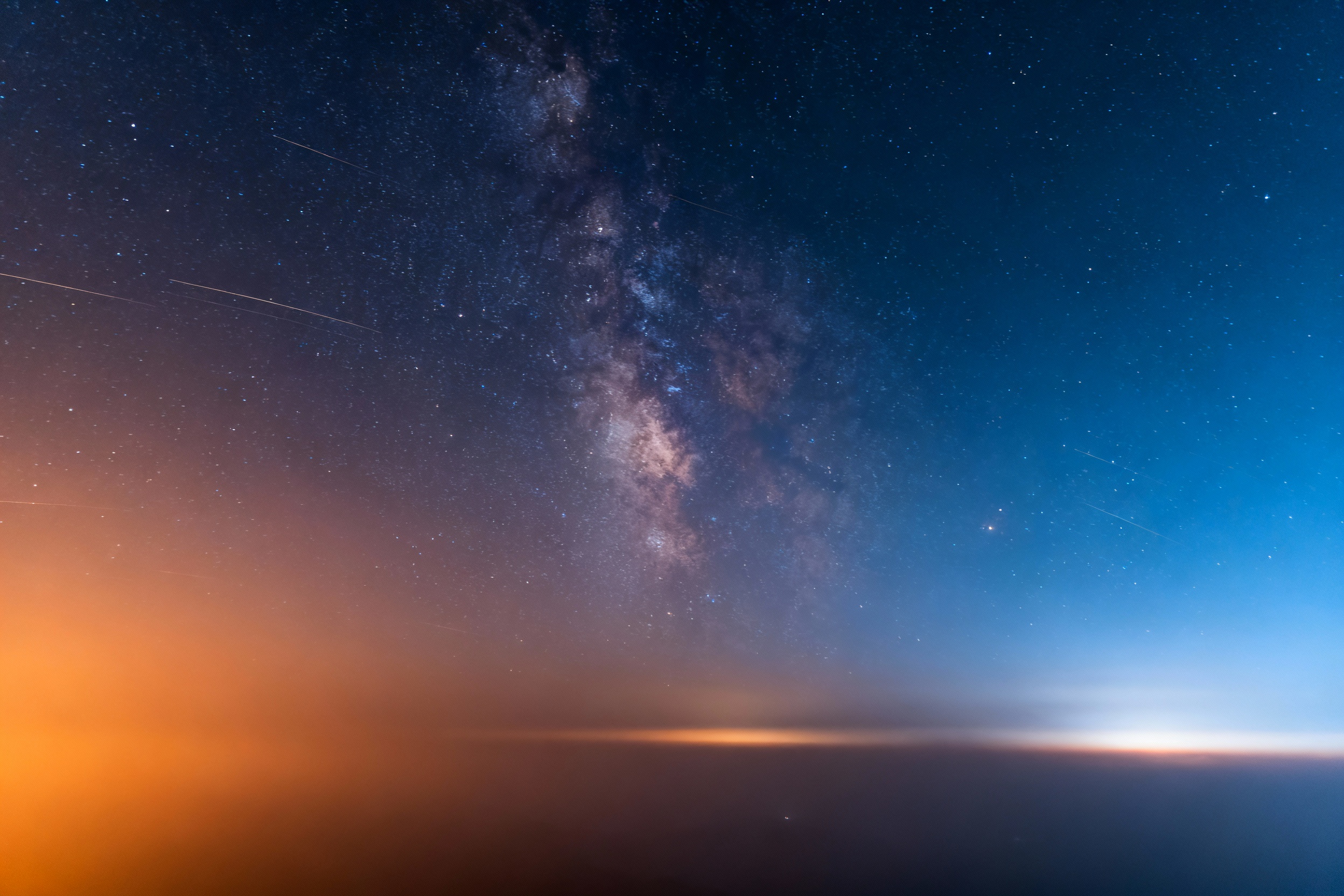
Light pollution gradients—the gradual transition from bright to dark areas in night sky images—pose significant challenges for astrophotographers and researchers. These gradients arise from artificial lighting, atmospheric scattering, and nearby light sources, creating uneven backgrounds that obscure celestial details. For instance, an image of the Milky Way might appear washed out near the horizon due to urban glow. Removing these gradients is essential to enhance faint stars, nebulae, and galaxies, enabling both artistic and scientific analysis.
Software Solutions for Gradient Removal
Modern software tools like PixInsight, Adobe Photoshop, and Siril offer specialized features for gradient correction. PixInsight’s DynamicBackgroundExtraction (DBE) allows users to sample background points across an image, creating a model of the gradient that can be subtracted. Photoshop’s gradient removal relies on gradient maps and selective masking, often combined with frequency separation techniques. Free alternatives like Siril use iterative background modeling to isolate and remove gradients. These tools vary in complexity but share a common goal: preserving astronomical data while eliminating unwanted illumination patterns.
Algorithm-Based Techniques: From DBE to Machine Learning
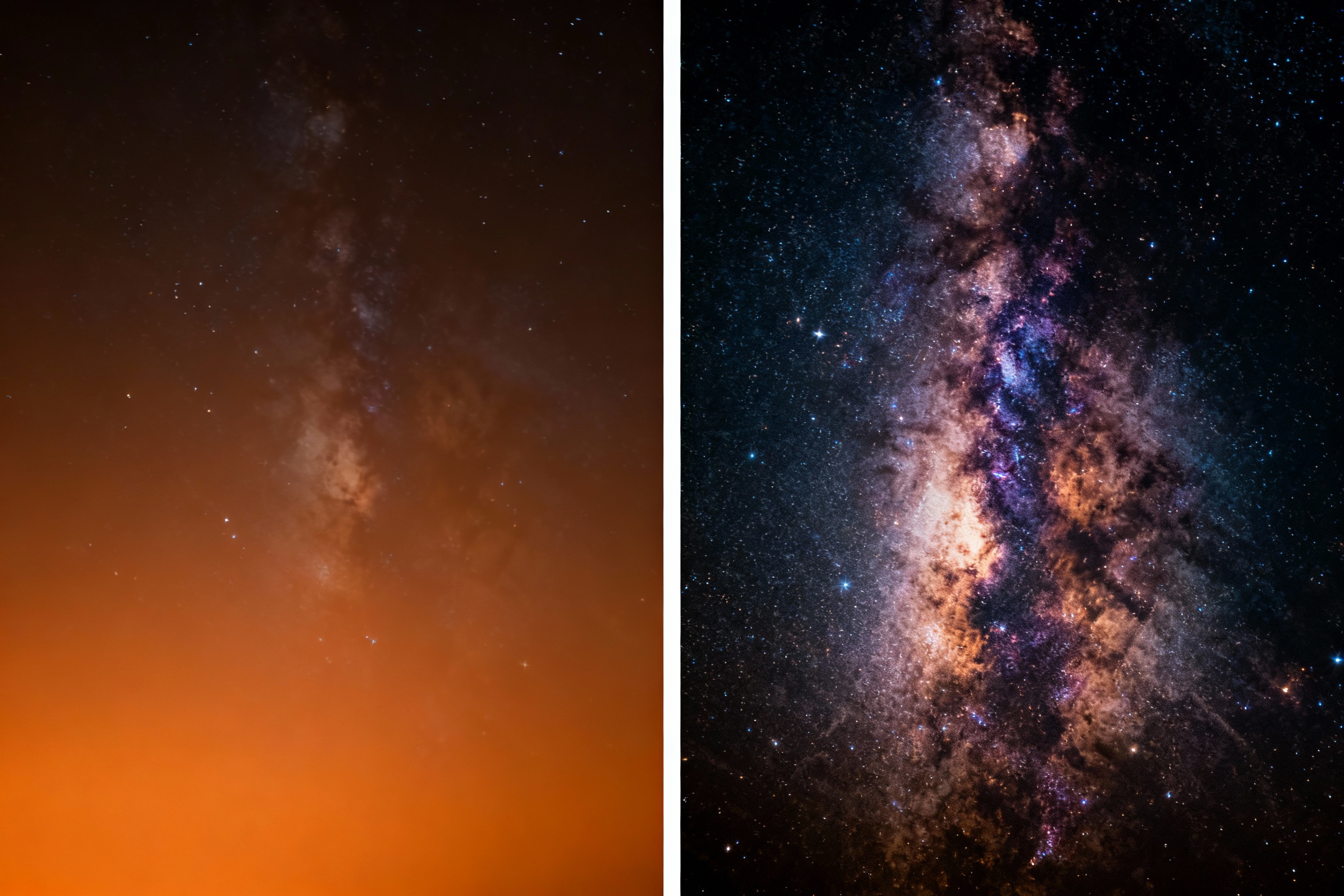
Algorithmic approaches automate gradient removal by analyzing image data mathematically. PixInsight’s DBE algorithm calculates polynomial surfaces to approximate the background, while AutomaticBackgroundExtraction (ABE) uses adaptive mesh grids. Newer methods leverage machine learning models trained on datasets of polluted and clean images, enabling real-time correction. For example, a convolutional neural network (CNN) can distinguish between light pollution gradients and genuine astronomical features, achieving results faster than manual methods. These algorithms excel in handling complex gradients, such as those caused by moonlight or hybrid urban-rural landscapes.
Observational Strategies to Minimize Gradients
Preventing gradients during data acquisition reduces post-processing effort. Strategies include using flat frames to calibrate out optical vignetting, shooting under moonless skies, and selecting remote locations with low light pollution. Light pollution filters, such as those blocking sodium-vapor wavelengths, can also mitigate gradients. For example, a broadband filter might preserve emission nebulae while suppressing urban glow. Timing observations around astronomical twilight and avoiding direct light sources further ensures cleaner raw data, laying a stronger foundation for gradient removal.
Real-World Applications in Astrophotography and Research
Gradient removal techniques empower both amateur astrophotographers and professional astronomers. In astrophotography, eliminating gradients transforms mediocre shots into gallery-worthy pieces, revealing structures like the Integrated Flux Nebula. Researchers use gradient correction to study faint galactic halos or transient events like supernovae, where precise background subtraction is critical. For example, the Hubble Space Telescope’s data pipelines incorporate gradient modeling to enhance deep-field images. These applications underscore the interdisciplinary value of mastering gradient removal.
Advancing Gradient Removal: Future Tools and Techniques
The future of gradient removal lies in integrating AI with multi-wavelength data. Tools may soon analyze infrared or narrowband data to inform visible-light corrections, addressing gradients at their source. Community-driven projects, like open-source neural networks trained on crowd-sourced astrophotography, could democratize access to advanced techniques. Meanwhile, improvements in sensor technology and space-based telescopes will reduce the prevalence of gradients, pushing the boundaries of what we can observe—and how effortlessly we can reveal the universe’s hidden details.